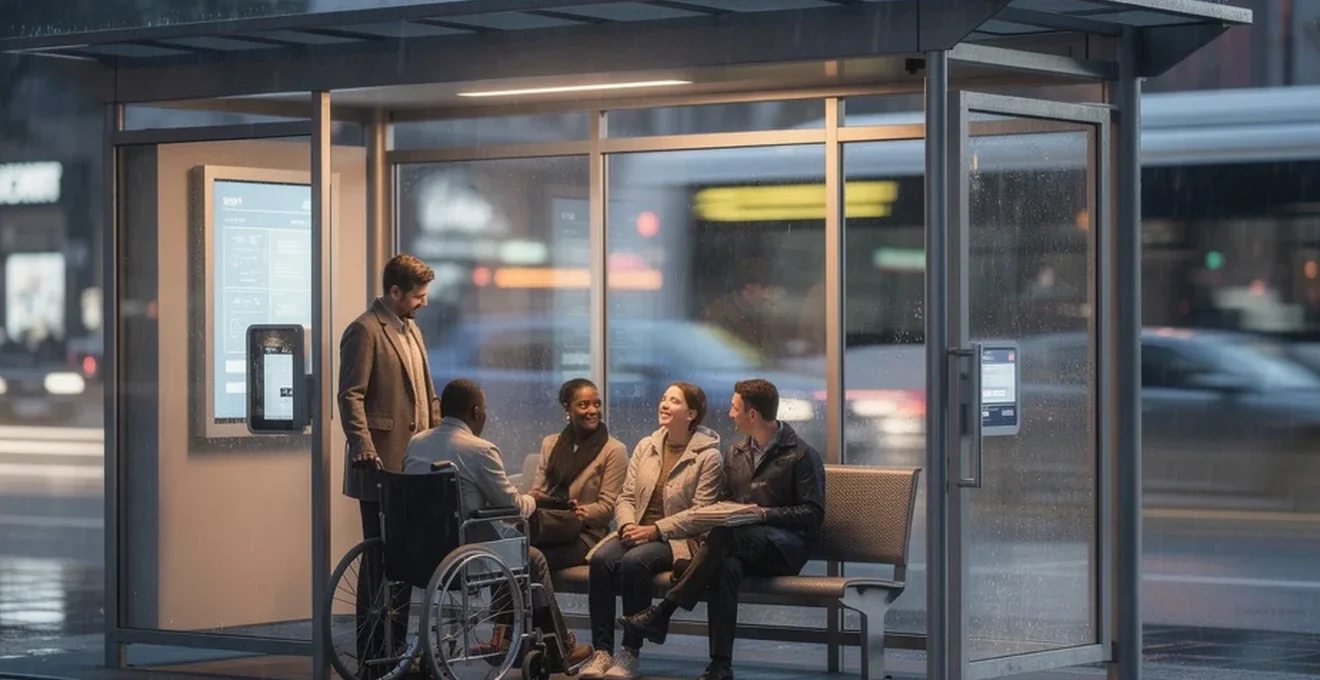
Waiting for a bus is often the least considered part of a journey, yet it shapes how passengers feel about the entire transport network before they even board. Research from Transport Focus and Clear Channel UK, based on feedback from more than 3,000 bus passengers across Great Britain, confirms that shelter quality directly affects satisfaction, accessibility and perceived safety. Bus stops and the boarding experience are, in fact, the third biggest influence on overall passenger satisfaction. This article examines what makes a shelter genuinely effective, from the psychology of waiting and the materials used in construction, to accessibility standards, smart technology and the practicalities of long-term maintenance. Whether you are a transport authority, urban planner or simply curious about why some shelters feel better than others, the following sections set out the evidence and standards behind good shelter design.
Passenger experience metrics and Wait-Time perception in transit networks
The way passengers experience waiting time is rarely a straightforward reflection of the minutes on a clock. It is shaped by comfort, information and a sense of control over the situation. Transport authorities that understand this gap between perceived and actual wait times are better placed to design shelters that genuinely improve satisfaction rather than simply providing a roof overhead.
Perceived wait time versus actual wait time: the TCRP report 100 findings
It is a well-established principle in transit planning that passengers tend to overestimate how long they have been waiting, particularly when that wait is uncomfortable, uninformed or feels unsafe. A shelter that fails to protect against weather, offers no seating and provides no indication of when the next bus will arrive stretches a five-minute wait into what feels like a much longer ordeal. Addressing this perception gap is not simply about cosmetic improvements; it requires tackling the practical shortcomings that make waiting unpleasant, since passengers judge the reliability of a whole network partly on the quality of the infrastructure at the roadside.
Weather exposure and its impact on modal shift away from public transport
Exposure to rain, wind and direct sunlight is one of the most immediate deterrents to bus use. Effective shelters should provide a roof, sides and, ideally, a back panel to guard against wind and rain, with some designs adding a front panel for extra protection. When shelters fail on this basic function, passengers experience a moment of discomfort that
colours their entire perception of public transport as an inconvenient, uncomfortable option compared with the shelter of a private car. This matters at a strategic level too: public transport is competing directly against the comfort and control of car ownership, and if authorities want people to leave their cars at home, the experience of waiting must become significantly more attractive.
Ergonomic seating design and dwell comfort at bus stops
Seating is one of the clearest examples of a small design detail with an outsized impact on satisfaction. Research found that only 15 per cent of passengers considered existing seating comfortable, a striking figure given how central seating is to the waiting experience. Seating needs are not uniform either: children, pregnant women, older people and disabled passengers all benefit from adequately sized, well-positioned seating, and the number of seats provided should reflect how busy a particular stop becomes. Materials commonly used include timber plank benches, moulded plastic seats and epoxidated laminate benches, all of which offer durability alongside comfort when properly specified and maintained.
Real-time passenger information displays and anxiety reduction
Uncertainty is one of the biggest sources of frustration for waiting passengers. Accurate real-time information was repeatedly cited by passengers as a necessary improvement, and clear signage on schedules, routes and service changes helps reduce the anxiety associated with not knowing when a bus will arrive. Digital displays, alongside more traditional timetable cases, give passengers a sense of control over their journey. For those unfamiliar with a route, such as tourists, this information is particularly valuable, and QR codes offering mobile access to timetables and route maps add a modern layer of convenience without requiring additional infrastructure.
Structural engineering and material selection for bus shelters
Behind every well-functioning shelter lies a set of engineering decisions about frame construction, panelling and weather resistance. These choices determine not only how comfortable a shelter feels day to day, but how well it withstands vandalism, salt corrosion and structural loads over years of use.
Tempered glass versus polycarbonate panelling in High-Vandalism zones
Panel material has a significant bearing on both durability and visibility. Herculite glass side panels, of the type used in New York City, resist scratching, are strong, shatter-resistant and easy to clean, making them well suited to locations with a higher risk of vandalism. Polycarbonate is also widely used because of its durability and transparency, allowing natural light into the shelter while shielding passengers from wind and rain. Plastic or standard Plexiglas, by contrast, is generally not recommended, as it tends to discolour and scratch over time, reducing the visibility that passengers rely on to see an approaching bus.
Galvanised steel frameworks and corrosion resistance standards
A solid, structural frame capable of supporting a roof and side panels is fundamental to a durable shelter. Steel is generally regarded as the best material for this purpose, offering strength without the appearance issues associated with concrete, which tends to look monolithic and discolours or soils easily. Wood, while sometimes used for seating elements, is less durable as a structural material. Galvanised or powder-coated steel frames resist corrosion, and a protective finish can be applied in areas where road salt causes particular damage. Steel also has the advantage of being highly recyclable without losing strength, supporting long-term sustainability goals alongside structural performance.
Wind load calculations for cantilevered roof canopies
Roof design must balance weather protection with structural stability, particularly for cantilevered canopies that extend without a supporting column at the front edge. A well-designed frame needs to accommodate the roof securely while withstanding wind loading, especially in exposed or high-traffic locations. Bolted attachment, rather than components cast in place, offers the flexibility needed for installation and future adjustment, while minimising the number of movable parts reduces the risk of structural failure or breakage over time.
BS EN 1090 compliance for structural steelwork in the UK
For structural steelwork used in UK bus shelters, compliance with recognised fabrication and installation standards is essential to ensure long-term safety and durability. Beyond meeting a specific standard, the broader principle is that shelters should be composed of proper structural members and inset panels, not the kind of snap-together curtain walls or decorative sections that are easily damaged or vandalised. Parts should be easy to reorder and replace without requiring the removal of other sections, which keeps repair costs manageable and downtime to a minimum.
Accessibility standards and inclusive design in shelter infrastructure
Accessibility is not a peripheral consideration in shelter design; it is central to whether a shelter functions for the full range of people who need to use it. Research shows that 65 per cent of visually impaired passengers and 61 per cent of mobility-impaired passengers struggle to use current shelters, a finding that underlines how far standard designs still have to go.
DDA and equality act 2010 compliance for wheelchair users
Shelters must be designed to accommodate all users, including wheelchair users, in line with equality and accessibility legislation. This means positioning shelters at a suitable height and distance from the kerb to facilitate easy boarding and alighting, and ensuring there is sufficient clear space for wheelchairs to manoeuvre within and around the shelter itself. Where the surrounding surface is uneven, ramps should be provided to remove physical barriers to access.
Tactile paving integration at shelter boarding points
Tactile paving plays an important role in helping visually impaired passengers identify the boarding point safely and confidently. Combined with clear signage and well-designed lighting, tactile features help address the significant challenges that visually impaired passengers currently face when navigating bus stops, challenges that were highlighted as a priority area for improvement in recent passenger research.
Low-level seating and priority space allocation
Seating design should account for a range of physical needs, including passengers who require lower seating heights or additional space for mobility aids. Allocating priority space within the shelter, alongside general seating, ensures that disabled passengers are not forced to wait outside the shelter’s weather protection because the internal layout has not accounted for their needs. As disability equality charity Scope has noted, accessibility benefits the entire community, and it should never be an afterthought when services and facilities are introduced.
Smart shelter technology and digital passenger integration
Technology is increasingly central to how shelters function, extending their role from simple weather protection to active hubs of information, safety and connectivity.
Solar-powered LED lighting systems in Off-Grid locations
Lighting is one of the most consistently cited safety concerns among passengers, with nearly half reporting that dim or broken lighting severely affects their sense of security, particularly after dark. Solar-powered LED lighting offers a practical solution, especially in locations without easy access to mains power, reducing reliance on non-renewable energy while improving visibility and passenger confidence at night.
USB charging ports and 5G-Enabled Wi-Fi hotspots
As passengers increasingly expect the same quality of environment they encounter elsewhere in daily life, features such as charging points and connectivity are becoming part of what a modern shelter should offer. These additions support the wider ambition of making public transport infrastructure feel current and considered, rather than a purely functional afterthought bolted onto the roadside.
Integration with transport for london’s countdown API
Digital displays showing accurate, real-time arrival information directly address one of the clearest passenger demands identified in recent research. Integrating live data feeds into shelter displays reduces uncertainty and helps passengers plan their journeys with confidence, reinforcing the link between good information provision and a reduced sense of anxious waiting.
Urban planning considerations for shelter placement
Where a shelter is placed can matter just as much as how it is built. Good placement decisions draw on principles of visibility, safety and passenger flow, ensuring the shelter integrates well with its surroundings rather than sitting as an isolated structure.
Sightline analysis for crime prevention through environmental design (CPTED)
Good locations for bus shelters include areas near retail premises open late at night, close to office entrances within view of a security guard, or alongside other amenities such as telephones and benches. Transparent materials help maintain sightlines both into and out of the shelter, allowing passengers and passing drivers to see each other clearly, which increases the sense of security. Shelters positioned where natural surveillance is limited are more vulnerable to antisocial behaviour and feel less safe to wait in, particularly at night.
Footfall modelling near interchange hubs such as birmingham new street
Shelters located near busy interchange hubs need to accommodate higher passenger volumes and more complex movement patterns than a quiet suburban stop. Areas with frequent service and high ridership levels are precisely the locations where shelter provision is most needed, and sizing decisions should reflect anticipated footfall rather than a one-size-fits-all approach. A shelter appropriate for a low-frequency rural route will rarely suit a busy city-centre interchange, where crowding, queuing and rapid boarding all need to be accounted for in the layout.
Maintenance protocols and lifecycle cost analysis
The long-term success of a bus shelter depends as much on how it is maintained after installation as on how well it is designed and built in the first place. A shelter that looks neglected quickly becomes a target for further damage, while one that is well cared for tends to be treated with more respect by the public.
Anti-graffiti coatings and cleaning frequency benchmarks
Materials should be resistant to vandalism, graffiti, weather, salt and rust, and should be easy to clean without specialist intervention. There is considerable evidence that a well-maintained shelter is better respected and less subject to vandalism than one that is allowed to deteriorate. A sound maintenance programme should also aim to minimise the amount of litter collection, cleaning and minor repair required in the first place, through careful material selection and design.
Total cost of ownership comparisons: clear channel versus JCDecaux models
Financing and maintenance models vary between providers, and many local authorities now rely on private contractors to construct and maintain shelters at no direct public cost, funded instead through advertising revenue generated by the shelters themselves. Where this approach is used, it is important that design standards, locations and passenger amenities are clearly specified within the contract between the city and the contractor, so that cost efficiency does not come at the expense of passenger experience. Continued dialogue between organisations such as Transport Focus, the Department for Transport and the wider bus industry is exploring whether a national standard for bus shelters, with specified minimum facilities, could help ensure consistency across providers and regions.